AI Chatbot for Purchase Order Management: 2026 Guide
Reduce PO processing costs by 80% with an AI chatbot. Learn how fleet and logistics teams automate purchase orders, cut errors, and save $400K+ annually.
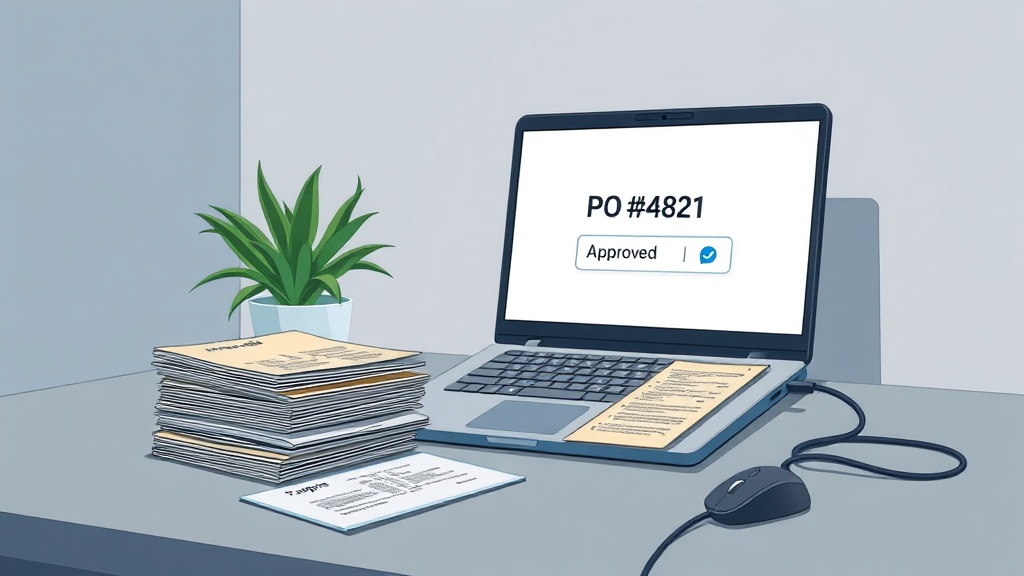
Every procurement professional knows the feeling — a desk buried in email threads, spreadsheet tabs that never seem to sync, and approval chains that take days to resolve a single purchase order. Manual PO processing costs companies between $15 and $40 per order, according to industry benchmarks. For logistics and fleet operations processing thousands of orders monthly, that waste adds up fast. The AI procurement market is projected to grow significantly in 2026, and an AI chatbot for purchase order management is emerging as the most practical solution for companies ready to break free from manual workflows. This guide explores how AI chatbots transform PO management, the measurable returns, and how to find the right fit for your logistics or fleet business.
What Is an AI Chatbot for Purchase Order Management?
An AI chatbot for purchase order management is a conversational interface powered by natural language processing (NLP), a branch of AI that allows machines to understand and respond to human language. It handles PO creation, approval routing, vendor communication, and status tracking — all through simple chat commands. The distinction matters: unlike AI purchase order automation software that runs silently in the background, a chatbot puts a friendly "procurement assistant" directly in front of your team.
> [What exactly does an AI chatbot do for PO management?]: An AI chatbot handles PO creation, approval routing, vendor communication, and status tracking through conversational chat interfaces. It uses NLP to extract key details from user requests, checks business rules, and processes actions in seconds — without requiring users to navigate complex ERP menus.
How it works: A fleet manager types "Approve PO-4321 for 50 gallons of diesel from Shell" into a messaging interface. The chatbot extracts the key details using NLP, checks approval limits, routes the request to the right person, and updates inventory — all in seconds. Over time, the system learns from past approvals to suggest actions proactively, following the continuous improvement cycle (Plan-Do-Check-Act) made famous by W. Edwards Deming.
Key components include:
- Conversational UI — accessible via mobile, web, Slack, or Teams
- Approval logic engine — applies your business rules automatically
- Vendor database connection — pulls pricing, contracts, and lead times
- ERP integration — syncs with SAP, Oracle, NetSuite, or custom systems
Make no mistake: the chatbot doesn't replace your ERP. It acts as a smart front-end that makes procurement feel instant.
5 Key Benefits of AI in Purchase Order Management
The benefits of AI in purchase order management extend far beyond simple automation. Here are the five most impactful advantages for procurement teams in logistics and fleet operations.
Speed: 80–90% Reduction in Processing Time
Approvals that once required email chains and hours of follow-up now happen in seconds. A chatbot can validate a PO against budget codes, check vendor contracts, and route for approval faster than any human can open their inbox. For a fleet manager approving fuel orders on the go, that speed translates directly to fewer delays and faster truck turnaround.
Accuracy: Eliminate Costly Manual Entry Errors
Manual data entry carries a 10–15% error rate in PO processing — incorrect quantities, wrong vendor codes, misapplied budget categories. Each error triggers rework, vendor disputes, and delayed shipments. AI chatbots extract data from emails, scanned documents, and voice inputs with near-perfect accuracy, reducing error rates to under 2%.
Cost Savings: Slash Per-PO Expenses
Processing a single PO manually costs $15 to $40 when factoring in labor, corrections, and overhead. An AI chatbot brings that cost below $5 per PO. Consider a mid-size logistics company processing 2,000 POs per month: that's roughly $24,000 in annual labor savings alone, not including error-related costs.
Visibility: Real-Time Status Tracking
"Where is PO-5678?" Instead of emailing three people and waiting, your team asks the chatbot. It returns the current status, estimated approval time, and any blockers — instantly. This transparency eliminates status-check meetings and improves vendor relationships.
Scalability: Handle 3x Volume Without Adding Headcount
Peak seasons, fleet expansions, or sudden demand spikes no longer require hiring temporary procurement staff. An AI chatbot scales effortlessly, processing thousands of POs with the same response time as a dozen.
Fleet/logistics example: A logistics company with 50 fleet operators processes bulk fuel orders, maintenance POs, and parts procurement through a single chatbot interface, eliminating spreadsheets and email chains entirely.
AI Chatbot vs. Traditional Procurement Software: Which Is Right for You?
The choice between an AI chatbot and traditional procurement software isn't always straightforward. Each has distinct advantages depending on your company's size, tech stack, and operational complexity.
| Feature | AI Chatbot | Traditional Procurement Software |
|---|---|---|
| Learning curve | Low (conversational) | High (training required) |
| Implementation speed | 4–8 weeks | 3–12 months |
| Mobile readiness | Native conversational interface | Often limited |
| Customization | High (custom-built per workflow) | Moderate (configurable modules) |
| Integration depth | API-first, connects to any system | Native to specific ERPs |
| Cost model | Project-based, predictable | License + maintenance fees |
When to choose traditional software: You have a large centralized procurement team with established ERP modules. You need comprehensive reporting dashboards and audit trails built into the system.
The smart middle ground: Many companies use both — the chatbot as a user-friendly front-end and traditional software as the back-end data warehouse. Custom AI procurement agents can bridge this gap, integrating with your existing ERP while delivering a chat-based experience.
Fleet/logistics example: A fleet owner with 200 trucks needs POs approved from the road. A mobile chatbot is ideal. A corporate procurement team with 50 suppliers may benefit from both — a chatbot front-end for field staff and a traditional ERP back-end for central oversight.
How to Automate Purchase Order Processing with AI (A Step-by-Step Guide)
To learn how to automate purchase order processing with AI, follow this structured implementation roadmap. Most companies complete the process in 4 to 8 weeks.
> [How long does it take to automate POs with AI?]: A well-planned AI chatbot deployment takes 4 to 8 weeks from audit to go-live. The process includes auditing current workflows, defining automation goals, integrating with your ERP, customizing the chatbot, pilot testing, team training, and continuous monitoring.
Step 1: Audit Your Current PO Process
Map every manual step — PO creation, email approvals, data entry, invoice matching. Identify the biggest bottlenecks and measure your current cost per PO. A fleet company might discover that fuel POs take an average of 3 days to approve due to multi-location routing.
Step 2: Define Automation Goals
Set specific, measurable KPIs: "We will reduce average approval time from 3 days to 2 hours. We will cut manual data entry errors to under 2%. We will free up 15 hours per week of procurement staff time."
Step 3: Choose Your Integration Approach
Will the chatbot integrate with your existing ERP (SAP, Oracle, NetSuite), or operate as a standalone system with manual syncs? ERP integration unlocks the full ROI but requires 2–4 weeks of development. Standalone is faster but less powerful.
Step 4: Customize the Chatbot
Train the chatbot on your PO templates, vendor list, approval hierarchy, and business rules. For a logistics company, this means teaching it to differentiate fuel POs from maintenance POs and apply different approval workflows to each.
Step 5: Test with a Pilot Group
Run 50–100 real POs through the chatbot in parallel with your manual process. For a fleet, the pilot might be "all diesel fuel POs for the California fleet." Collect feedback, refine the chatbot's responses, and resolve any edge cases.
Step 6: Deploy and Train Your Team
Onboard procurement staff, fleet managers, and key vendors. Set up mobile access so field staff can initiate and approve POs from anywhere. Most teams adapt within a week.
Step 7: Monitor and Optimize
Track metrics — time per PO, error rate, user adoption rate, vendor satisfaction. The chatbot learns from every interaction, so performance improves over time. Review monthly and adjust business rules as needed.
What Real-World ROI Can You Expect from AI PO Automation?
The numbers behind AI PO processing time savings tell a compelling story. Here is the data that matters for procurement decision-makers.
The Numbers That Matter
- Manual PO cost: $15 to $40 per order
- Manual error rate: 10–15%
- AI chatbot time reduction: 80–90%
- AI chatbot error rate: under 2%
| Metric | Manual Processing | AI Chatbot | Improvement |
|---|---|---|---|
| Cost per PO | $15–$40 | Under $5 | 80–88% reduction |
| Processing time per PO | 15–30 min | 1–3 min | 80–90% faster |
| Error rate | 10–15% | <2% | 80–87% reduction |
| Monthly cost (2,000 POs) | $50,000 | $10,000 | $40,000 savings |
A company processes 2,000 POs per month at $25 per PO manually — that is $50,000 per month in processing costs. After implementing an AI chatbot at $5 per PO, monthly costs drop to $10,000. Annual savings: $480,000. The payback period is typically 3 to 6 months for a custom solution.
Fleet/logistics example: A fleet of 500 trucks processes 1,500 POs per month for fuel, tires, parts, and maintenance. At $30 per PO manually, that is $45,000 per month. With an AI chatbot at $5 per PO, costs drop to $7,500 per month. Annual savings: $450,000. Plus, faster parts procurement reduces truck downtime.
Intangible benefits include fewer vendor disputes, faster supplier payment (improving relationships), and freed-up procurement staff who can focus on strategic vendor negotiations rather than chasing approvals.
Choosing a Custom AI Procurement Agent for Your Logistics Business
When evaluating a custom AI procurement agent for logistics, the build-versus-buy decision deserves careful consideration. Off-the-shelf procurement software often falls short for complex, multi-vendor, multi-location operations.
> [Should I build or buy an AI procurement solution?]: Off-the-shelf tools often fail logistics companies because they can't handle fleet-specific needs like multi-location approval rules, fuel price fluctuations, or mobile-native experiences. Custom AI procurement agents offer higher ROI because they are trained on your specific vendor contracts, approval hierarchies, and compliance rules — and they integrate directly with your TMS and accounting systems.
Why off-the-shelf tools fail logistics companies:
- Generic tools don't handle fleet-specific needs like multi-location approval rules
- They struggle with fuel vendor price fluctuations and dynamic pricing
- They can't distinguish between maintenance spend, operational spend, and capital purchases
- Mobile experiences are often afterthoughts, not native features
What a custom AI procurement agent looks like:
It is trained on your specific vendor contracts, approval hierarchies, budget codes, and compliance rules. It integrates with your transportation management system (TMS) and accounting software. It learns your patterns: "Automatically approve any PO from vendor X under $5,000." It includes fleet-specific features like geolocation-triggered POs, fuel price alerts, and mobile approval from any device.
Industries that benefit most include logistics and transportation (fleet management, multi-location procurement), healthcare (compliance-heavy PO workflows), and real estate (property-level purchase tracking).
An expert partner like Clearframe Labs maps your specific workflows, trains custom models, and deploys within 4 to 8 weeks. No one-size-fits-all templates.
Frequently Asked Questions
Can an AI chatbot work with my existing ERP?
Yes. Custom AI chatbots are built API-first and can integrate with most major ERPs including SAP, Oracle, NetSuite, and Microsoft Dynamics. Integration typically takes 2–4 weeks.
How much does a custom AI procurement chatbot cost?
Pricing is project-based and depends on workflow complexity, number of integrations, and customization depth. Most deployments pay for themselves within 3–6 months through labor savings alone.
Will my team need extensive training to use it?
No. The chatbot uses a conversational interface similar to text messaging or Slack, so most teams adapt within a few days. No formal training or technical skills are required.
Is it secure for sensitive procurement data?
Custom AI agents can be deployed with end-to-end encryption and role-based access controls. Data stays within your infrastructure. Industry research suggests custom deployments offer superior security compared to SaaS procurement tools.
What happens if the chatbot encounters a request it can't handle?
The chatbot escalates the request to a human team member with full context of the conversation. Critical approvals always have a manual fallback path.
Can it handle POs in multiple languages?
Yes. NLP models can be trained to understand and process POs in English, Spanish, and other major languages — useful for multi-region fleet operations.
Getting Started with AI for Your Purchase Orders
The numbers speak for themselves. A logistics director with 300 trucks can reduce PO processing time from 4 hours to 15 minutes per day — freeing them to focus on strategic vendor negotiations rather than chasing approvals. The annual savings of $450,000 or more make the investment self-funding within months.
Implementation is faster than most expect. A well-executed AI chatbot deployment takes 4 to 8 weeks from audit to go-live. The first step is a conversation — mapping your current workflows and identifying where automation delivers the greatest impact.
Final Thoughts
AI chatbots are transforming purchase order management from a back-office headache into a competitive advantage for logistics and fleet businesses. With 80–90% time reductions, error rates under 2%, and annual savings exceeding $400,000 for mid-size operations, the ROI is undeniable. The AI procurement market is only accelerating through 2026, making right now the ideal moment to adopt.
Ready to automate your procurement process? Speak to someone on the Clearframe Labs team about a custom AI procurement agent tailored to your logistics business. To learn more, visit Clearframe Labs. The next step is simple: start mapping your current PO process and identify where a chatbot will deliver the greatest immediate return.