AI-Driven Sales Forecasting for Startups: A 5-Step Implementation Guide
Learn to implement AI-driven sales forecasting for your startup in 5 steps. Reduce forecast errors from 30% to 10-15% with clean CRM data and custom models.
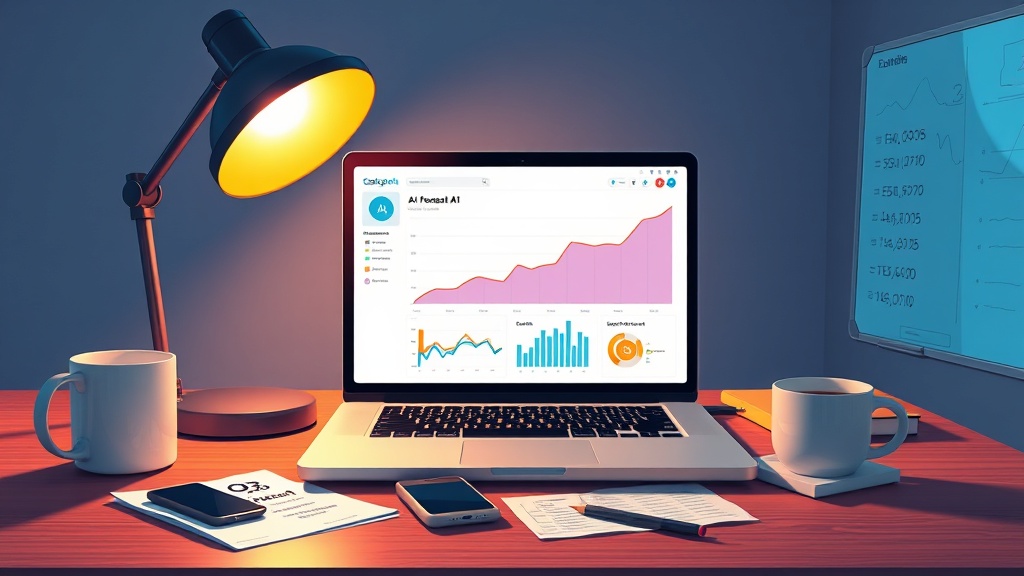
When your startup's runway depends on accurate revenue projections, a spreadsheet error isn't a "close call"—it's an existential risk. You know the feeling: staring at a static row of numbers that fails to account for the market shift your sales team just flagged or the sudden churn spike from two quarters ago. The frustration is that those spreadsheets cost time and money, but you're not sure what the alternative is.
This guide walks you through a practical five-step process to implement AI-driven sales forecasting for startups, from cleaning up messy CRM data to deploying a custom prediction dashboard. You'll learn exactly what tools to use, how to choose between off-the-shelf and custom solutions, and the quickest path to a more accurate revenue forecast. If you have at least 12 months of historical sales data and access to your CRM, you have everything you need to start.
Why AI-Driven Sales Forecasting for Startups Matters More in 2026
AI-driven sales forecasting for startups turns historical data, market signals, and customer behavior patterns into revenue predictions that are three to five times more accurate than traditional spreadsheet models. A startup at $5 million ARR losing $200,000 due to forecast errors is losing four percent of revenue — often the difference between profitability and failure.
Traditional forecasting relies on linear regression and human intuition, which are biased toward optimism. AI models learn from seasonality, lead velocity, and churn patterns that spreadsheets simply miss. There's also an important distinction: predictive models tell you what will happen, while prescriptive models — what firms like Clearframe Labs specialize in — tell you what to do about it. The former gives you a number; the latter gives you an action plan.
> Why should startups switch from spreadsheets to AI forecasting? AI-driven sales forecasting reduces error margins from 30 percent to 10–15 percent by learning from seasonality, lead velocity, and churn patterns that manual methods miss. This translates to hundreds of thousands of dollars in preserved revenue for growth-stage startups.
Common Startup Forecasting Myths Debunked
- Myth One: "I need perfect data." Clean data helps, but most ML models handle moderate messiness with feature engineering.
- Myth Two: "AI eliminates all error." No model is perfect. The goal is to reduce error margins from 30 percent to 10–15 percent.
- Myth Three: "It costs too much for a small team." Cloud-based model training and open-source libraries make entry-level forecasting accessible for under $5,000.
Step 1: Audit and Prepare Your Historical Sales Data for AI
To prepare your sales data for AI forecasting, you need at least 12 to 18 months of clean, structured CRM data with no gaps, duplicates, or inconsistent formatting. This startup sales data preparation process is the foundation of everything that follows.
For most startups, this is the hardest step — not because the work is complex, but because no one has done it before. Startups tend to have messy data: missing fields, inconsistent deal stages, unlogged churn events, and notes crammed into free-text fields. Run through this checklist:
- Remove duplicate entries (merge or drop rows with identical close dates and values).
- Standardize currency and date formats across all entries.
- Fill in missing close dates using deal-stage velocity averages.
- Flag and temporarily exclude anomalous deals (e.g., a one-time partnership worth $1 million in a sea of $10k contracts).
Think of training data like fuel. Garbage in gives you garbage out. Clean data is premium gasoline for your AI model. Clearframe Labs' AI development services include data pipeline audits that catch these issues before they corrupt your model. The estimated ROI here is meaningful: startups that invest two to three weeks in data cleanup typically see a 20 to 30 percent improvement in forecast accuracy.
> How do I clean my CRM data for AI forecasting? Remove duplicates, standardize currency and date formats, fill missing close dates using historical deal-stage velocity, and flag anomalous deals. This two- to three-week investment typically yields 20–30 percent improvement in forecast accuracy.
Custom AI Forecasting vs. Off-the-Shelf Tools: Which Is Right for Your SMB?
The right choice between custom AI forecasting vs. off-the-shelf tools for SMBs depends on your startup's data complexity, growth stage, and whether your sales cycle has unique quirks that generic models can't capture. This decision sets the trajectory for your entire implementation.
| Factor | Off-the-Shelf (e.g., Clari, Gong) | Custom AI Solution |
|---|---|---|
| Setup time | 2–4 weeks | 4–8 weeks |
| Customization | Fixed dashboards | Fully tailored to your data |
| Cost (annual) | $20k–$100k+ | $50k–$150k (one-time build) |
| Accuracy improvement vs. Excel | 15–25% | 30–50% |
| Requires clean data | Yes, but handles minor mess | Yes, needs very clean data |
AI vs. Traditional Sales Forecasting: Why Spreadsheets Fail Startups
AI vs traditional sales forecasting comes down to a fundamental difference in assumptions. Traditional sales forecasting using spreadsheets fails startups because it assumes linear growth, ignores external market signals, and relies on human intuition that's biased toward optimism.
According to industry research, the majority of startups miss their forecasts by 30 percent or more when using manual methods. Here's how the approaches differ:
- Spreadsheets: Linear regression, human-adjusted, assumes past equals future.
- AI models: Non-linear patterns, incorporates seasonality, adjusts for market changes in real time.
Traditional forecasting works for pre-revenue and very early-stage startups with less than six months of data — AI needs a minimum dataset. But for startups crossing the $1 million ARR threshold, the switch from spreadsheets to AI forecasting typically pays for itself in three to six months. At a 20 percent improvement in accuracy on $3 million ARR, that's $600,000 in better-informed decisions annually.
Step 2: How to Build an AI Sales Forecast Model for Your Startup
To build an AI sales forecast model for startups, start by selecting a modeling approach — Prophet for simplicity, XGBoost for complexity — and training it on your cleaned historical data. The right choice depends on your data volume and pattern complexity.
Model choice breakdown:
- Prophet (Meta): Best for startups with predictable seasonality and two-plus years of data. Handles missing data gracefully. Ideal for SaaS startups with monthly recurring revenue.
- XGBoost: Better for complex patterns like multiple lead sources, tiered pricing, and long sales cycles. Requires more data and careful hyperparameter tuning to avoid overfitting.
- LSTM neural networks: Overkill for most startups under $10 million ARR. Stick with simpler models unless you have a data science team.
Beyond model selection, you need a data pipeline — a daily CRON job that pulls from your CRM, stores data in a database (PostgreSQL or Snowflake), and feeds it into the model. This pipeline is the backbone of your system.
ROI note: A SaaS startup with $3 million ARR using Prophet reduced forecast error from 28 percent to 9 percent, preserving roughly $570,000 in inventory and staffing costs annually.
Step 3: Applying Machine Learning for Startup Revenue Prediction
Machine learning for startup revenue prediction works by training a model on your historical deal data, then using it to predict close probabilities, expected deal sizes, and timing for each opportunity in your pipeline. This shifts your forecast from a single guess to a probability-weighted portfolio.
Here's a concrete example: Imagine you have 50 open deals. A machine learning model scores each one by lead source, deal stage, time in pipeline, and company size. Instead of saying "I think we'll close 20 deals this quarter," it outputs: "15 deals at 80–90 percent probability, 10 deals at 50–70 percent, and the rest below 30 percent." That's a weighted forecast.
Key ML techniques used in practice:
- Time-series forecasting (Prophet): For top-down revenue prediction based on historical trends.
- Classification (Random Forest, XGBoost): For deal-level win probability — identifying which opportunities are most likely to close.
- Regression: For expected deal size — predicting the dollar value of each deal at the point of close.
Validation is critical. Use walk-forward cross-validation: train on months 1 through 9, test on months 10 through 12, then repeat. This mirrors real-world conditions where the model only sees past data. Clearframe Labs' machine learning page offers a deeper look into how these techniques are deployed for startup clients.
Step 4: Train, Validate, and Tune Your Forecast Model
You train and validate your AI forecasting model by splitting your historical data into training and testing windows, tuning hyperparameters, and measuring error metrics like MAPE (Mean Absolute Percentage Error). This AI forecasting model tuning process is where your model becomes trustworthy — or reveals its flaws.
Practical training workflow:
- Split data 80/20 — train on the first 80 percent of your timeline, test on the final 20 percent.
- For time-series data, use walk-forward validation: train on period one, test on period two, then train on periods one and two, test on period three, and so on.
Key metrics to track:
- MAPE (Mean Absolute Percentage Error): Aim for under 15 percent. This measures percentage error relative to actual revenue.
- RMSE (Root Mean Square Error): Pair with MAPE for dollar-accurate predictions. It penalizes large errors more heavily.
Overfitting warning: If your model shows greater than 99 percent accuracy on training data but fails on test data, you've overfit. Reduce your feature count, increase regularization, or simplify the model. Overcoming overfitting in startup AI models is a common challenge — the solution is almost always to use fewer features and simpler models. A lean, validated model is far more useful than a complex one that memorizes noise.
Step 5: Integrate Your Custom AI App for Demand Forecasting
Integrating your custom AI app for demand forecasting means building a dashboard or API layer that feeds live predictions into your CRM, ERP, or operations tools so your team can act on forecasts in real time. A model sitting in a Jupyter notebook is useless — integration is what makes it valuable.
Dashboard example: Use Streamlit or Retool to build a frontend that shows your weekly forecast, confidence intervals (e.g., "our model is 90 percent confident revenue will land between $220k and $260k"), and a pipeline breakdown by sales stage. Your team checks this dashboard every Monday morning.
API integration: Build a REST endpoint that your CRM calls daily to update predictions. When new deals enter the pipeline, the model rescans and pushes updated forecasts to the dashboard automatically. This eliminates manual data pulls.
Workflow automation: The real value is when your forecast triggers action. When the forecast drops below a threshold, auto-alert the sales team or flag risky deals for review. Clearframe Labs builds workflow automations that make forecasts actionable, not just visual. Their AI development page covers how these integrations fit into a broader digital transformation strategy.
> How do I integrate my AI forecast model into daily operations? Build a REST API endpoint that connects to your CRM, create a live dashboard (using tools like Streamlit or Retool), and set up automated alerts when forecasts drop below thresholds. This turns your model from a static report into an actionable business tool.
Frequently Asked Questions
What is the minimum data required for AI-driven sales forecasting?
At least 12 to 18 months of clean, structured CRM data with consistent deal stages, close dates, and dollar values is recommended. Less than 12 months may still work with simpler models like Prophet, but accuracy will be lower.
How much does AI sales forecasting cost for a startup?
Off-the-shelf tools range from $20,000 to $100,000+ annually. Custom solutions range from $50,000 to $150,000 as a one-time build. Entry-level approaches using open-source libraries and cloud services can start under $5,000.
Can AI forecasting work for B2B startups with long sales cycles?
Yes. AI models are particularly effective for B2B startups because they can learn from multi-touch attribution, stakeholder engagement patterns, and deal-stage velocity — factors spreadsheets cannot capture.
How often should I retrain my sales forecast model?
Retrain monthly to account for market shifts, product changes, and sales process refinements. A quarterly review of model features and hyperparameters is also recommended to maintain accuracy as you scale.
What's the difference between predictive and prescriptive forecasting?
Predictive forecasting tells you what revenue will likely be. Prescriptive forecasting — which firms like Clearframe Labs specialize in — tells you what actions to take based on those predictions, such as which deals to prioritize or when to adjust pricing.
Start Building Your AI Sales Forecast Model
From messy CRM data to a live forecasting dashboard, you now have a complete blueprint for AI-driven sales forecasting for startups. The five-step process — audit your data, choose between custom and off-the-shelf, build your model, validate it, and integrate it — is repeatable and scalable.
The ROI is tangible. Even a 15 percent accuracy improvement at $3 million ARR preserves roughly $450,000 annually in better inventory, staffing, and financing decisions. That's real money for a growth-stage startup.
For startups in Austin, New York, San Francisco, or anywhere in the US, Clearframe Labs offers hands-on AI sales forecasting consulting Austin and nationwide services to accelerate your implementation. Their team specializes in building custom AI applications and workflow automations that turn raw data into an actionable revenue engine.
Additionally, once your model is live, commit to a monthly review cycle. The market shifts, your product changes, and your sales team refines its pitch — all of which can degrade model accuracy over time. A monthly check-in to retrain on the latest data and retune parameters keeps your forecast reliable as you scale.